Researchers at the King Abdullah University of Science and Technology (KAUST) Artificial Intelligence Initiative have unveiled a series of open-access, bilingual foundation models optimized specifically for scientific discovery. Trained on the university's Shaheen III supercomputing platform—which pairs thousands of advanced GPUs with high-throughput petascale storage—the models address a long-standing deficiency in scientific AI: the inability of commercial foundation models to parse Arabic technical and academic literature with rigorous mathematical precision.
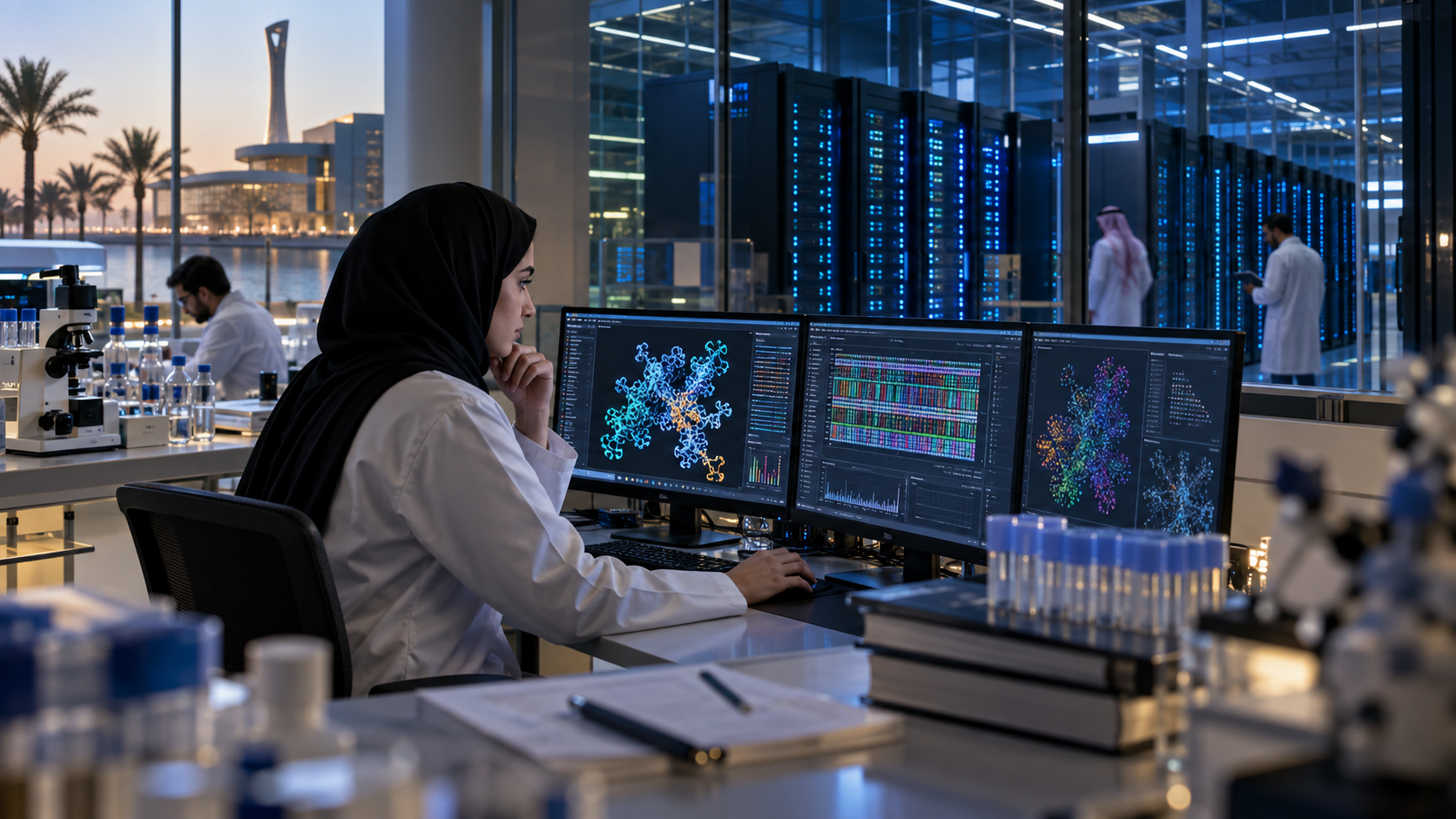
The research initiative focuses on three core domains critical to the Gulf's post-oil transition: genomics for arid-land crop resilience, computational catalysis for green hydrogen synthesis, and photovoltaic degradation modeling under extreme desert thermal conditions. By integrating specialized biochemical taxonomies and peer-reviewed Arabic academic archives with global scientific datasets, KAUST researchers created a model capable of generating literature syntheses, predicting molecular structures, and suggesting laboratory experimental protocols in both Arabic and English.
A central innovation of the KAUST project is its verifiable citation and reasoning engine. Unlike standard autoregressive models prone to inventing academic references, the KAUST architecture incorporates dense passage retrieval over indexed scientific repositories, validating every proposed chemical reaction against established thermodynamic laws before rendering an output. The platform is being made accessible to faculty and postgraduate researchers across Saudi universities, fostering a collaborative national research network.
The deployment underscores Saudi Arabia's dual strategy of funding both commercial industrial AI and fundamental academic research. As regional universities compete for global scientific talent, KAUST's commitment to open scientific models strengthens the Kingdom's standing as a serious contributor to frontier science. The next operational milestone will be validating lab results generated by the model in wet-lab experiments at the university's core research laboratories, turning algorithmic hypotheses into tangible patentable discoveries.
The institutional collaboration also establishes a transparent scientific benchmark for regional academic contributions. By making model weights, training parameters, and evaluation corpuses accessible to accredited academic researchers across the GCC, KAUST fosters a culture of open inquiry and verifiable scientific validation, ensuring that frontier model development within the region adheres to global standards of reproducibility and academic rigor.